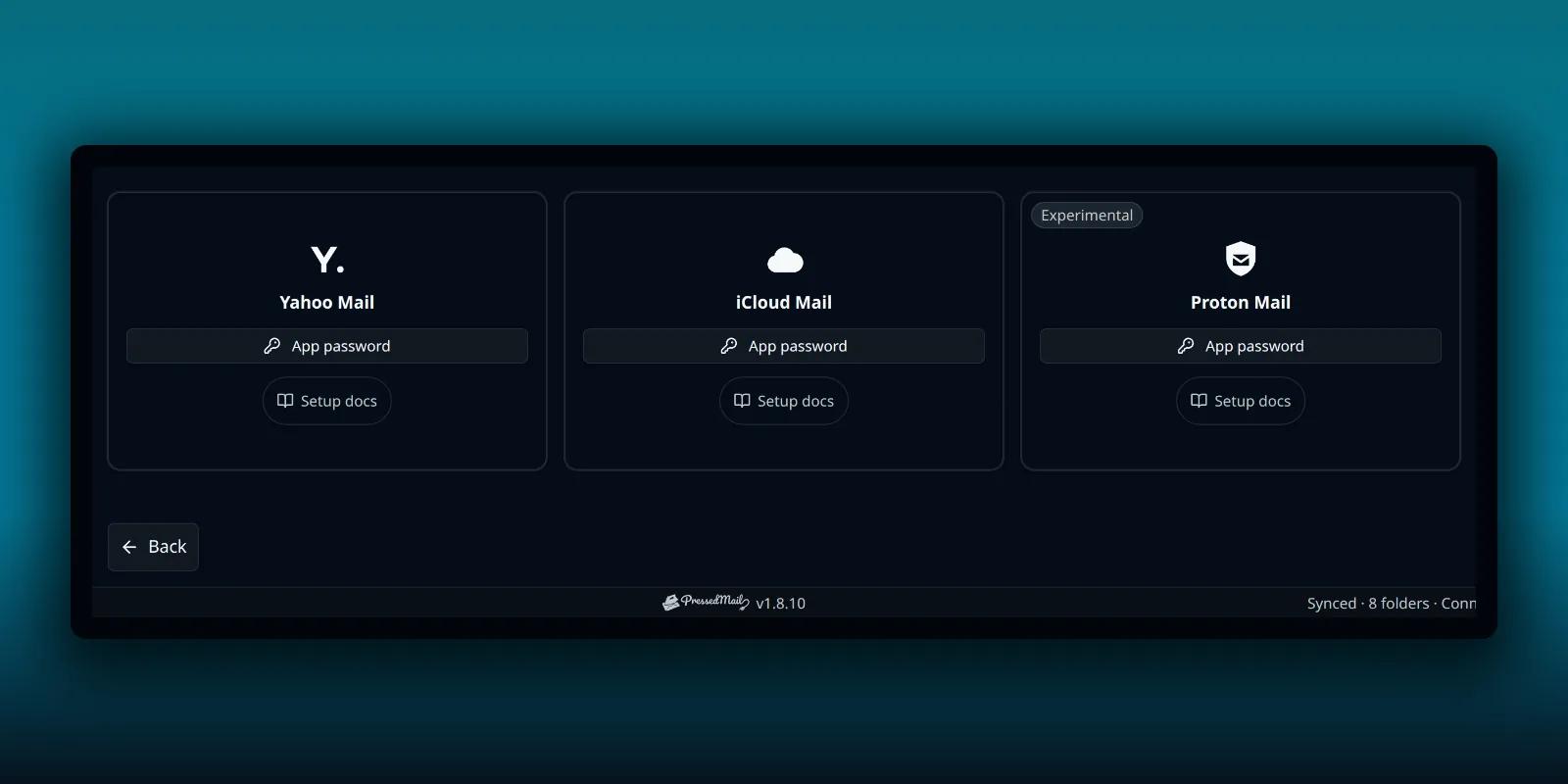
Proton Mail does not offer IMAP and SMTP to other mail clients directly. Proton’s official Bridge program adds them, and PressedMail’s Pro companion plugin runs that program on your WordPress server. This guide covers what you need, how the connection is made and what to watch for.
Proton Mail is marked Experimental on the provider screen. It needs PressedMail Pro and the separate companion plugin, so it is a paid-plan route.
What you need
- PressedMail Pro, active on the site.
- The Proton companion plugin, downloaded from the Downloads page of your PressedMail account next to the Pro download.
- A Linux server. The installer downloads Proton’s official Linux build and checks the checksum Proton published for it before anything runs.
- A host that lets PHP start background processes. If it disables those functions, Bridge cannot run, and the Proton Mail panel says so.
- A data directory outside your web root that the web server can write to. It holds Bridge’s local data, which is a signed-in copy of your mailbox.
- Your Proton address and password, and a two-factor code if the account uses one.
If any of those is missing, stop and fix it first. The server requirements checklist covers the general site requirements.
Install the companion
Install and activate the companion like any WordPress plugin, with Plugins, Add Plugin, Upload Plugin. PressedMail Pro must be active first, because the companion does nothing without it.
The companion adds no screen of its own. Its controls appear inside PressedMail, where you add the account.
Connect the mailbox
Open the settings with the Settings icon, go to the Accounts tab and choose Add Account. The provider screen lists Proton Mail with an Experimental badge.
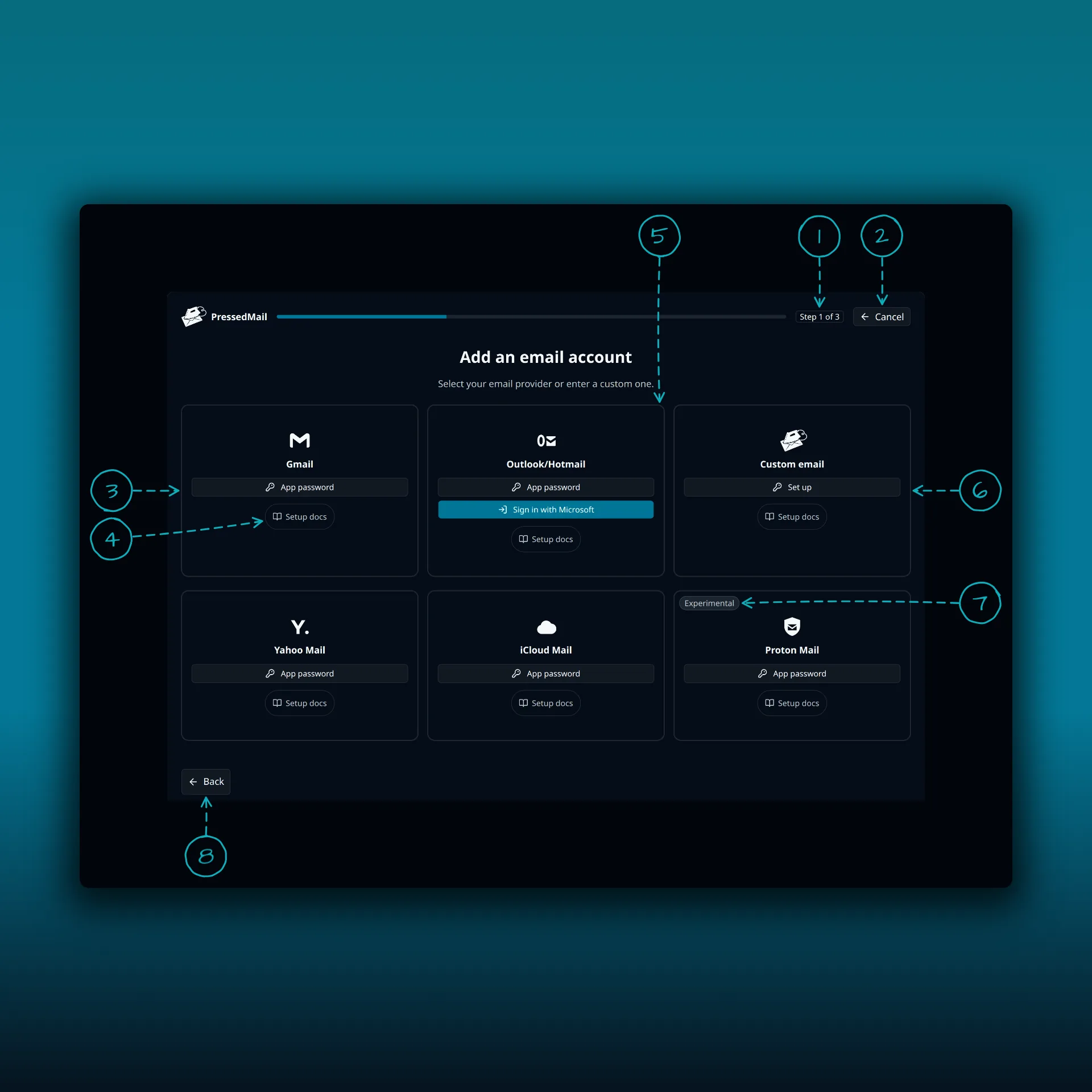
- The progress bar. This is step 1 of 3.
- Cancel.
- Gmail.
- Setup docs. Every card has one.
- Outlook/Hotmail.
- Custom email.
- The Experimental badge, shown on the Proton Mail card.
- Back.
With the companion active, choose Proton Mail and then work through the panel it opens.
- Confirm the data directory. The panel suggests one outside the web root, and you can choose another.
- Choose Install Bridge, then Start, and wait for the status to read running.
- Enter your Proton address, your password and a two-factor code when asked, then choose the mailbox.
- PressedMail creates the account through the same checks as any other provider and runs its connection test.
The mailbox then appears in the Accounts tab next to your other accounts.
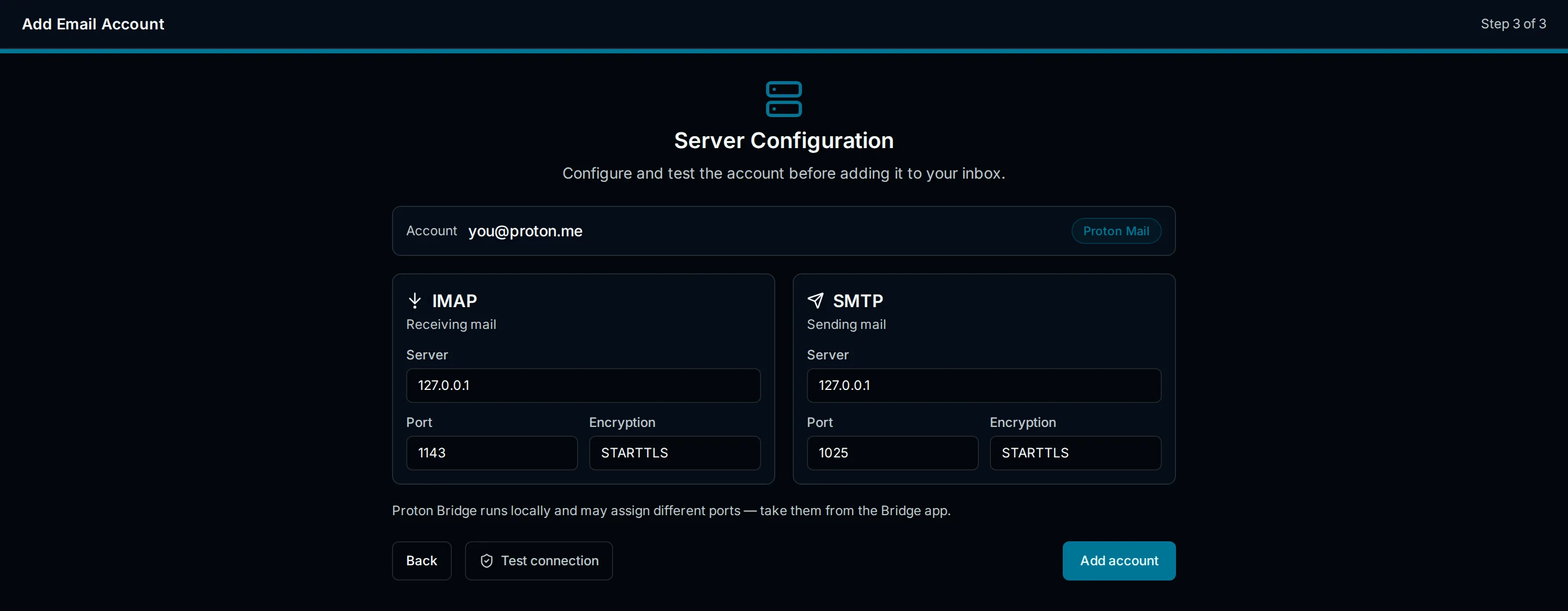
A screenshot of Proton Mail in the add-account list. Your screen may differ with the companion state.
How Bridge runs
Bridge runs as a background process on the server and listens on the server’s loopback interface only. A watchdog restarts it if it stops, and updating PressedMail does not interrupt it. The same panel stops and starts it.
Proton allows one Bridge instance at a time, so the panel will not start a second one while another runs.
Security notes
Your Proton password is used for the sign-in and is never stored. The local password Bridge generates is saved into your PressedMail account, sealed the same way as any provider credential, and removing the account removes it.
Do not expose Bridge to the internet. It binds to loopback and has no authentication of its own, so there is nothing to gain and a mailbox to lose.
The data directory holds your Proton login. Deleting it signs Bridge out of your account, so treat it as something you remove on purpose. Uninstalling the companion removes the plugin’s stored state but leaves Bridge and its data directory on the server.
If you change your Proton password, the credentials Bridge generated stop working. Sign in again from the Proton Mail panel and PressedMail updates the existing account instead of adding a duplicate.
When the server cannot run Bridge
If Install fails, the message names the library or function the server is missing. That is the package to ask your host about. A host that will not allow background processes cannot connect Proton Mail at all, and no setting in PressedMail changes that.
For other providers, the custom IMAP guide and the Yahoo and iCloud guides need no companion. Once the mailbox exists, a failed read or send follows the same steps as any other account in the delivery troubleshooting guide. Proton’s own account and security pages are the place to manage your login, and Proton’s Bridge documentation describes the program itself.
Frequently asked questions
Does Free support Proton Mail?
No. It needs PressedMail Pro and the companion plugin.
Do I need Proton’s desktop app?
No. The companion runs Proton’s Bridge program on the server, so there is no desktop app and no app password.
Is it safe to run Bridge on a shared host?
Only if the host allows the background processes Bridge needs and keeps its data directory outside the web root. If the host does not allow them, the panel tells you, and the connection cannot be made.
Why is it marked Experimental?
The badge is PressedMail’s own label for this route. Test it with harmless mail before you rely on it.
Manage your email inside WordPress
PressedMail Free adds an email client directly to your WordPress dashboard. Connect a compatible IMAP/SMTP mailbox, read and send mail, organize messages, and configure WordPress SMTP.